As Karate vs Taekwondo comparison takes center stage, this opening passage beckons readers into a world of martial arts that is rich in history and technique. Each discipline offers unique approaches to striking and self-defense, making them not just physical activities but also cultural phenomena.
Karate, with its roots deeply embedded in Okinawan traditions, emphasizes powerful punches and precise movements, while Taekwondo, originating from Korea, is renowned for its high-flying kicks and dynamic footwork. Understanding the differences and similarities between these two martial arts can offer valuable insights into their respective techniques, historical context, and the benefits they provide in today’s society.
Comparison of Karate and Taekwondo Techniques
Martial arts are rich in techniques and philosophies, with Karate and Taekwondo being two of the most practiced forms worldwide. Each discipline has its unique approach to striking and defense, reflecting their distinct cultural backgrounds and training methodologies. Understanding these differences can help practitioners choose which martial art aligns best with their goals.Karate emphasizes powerful strikes that utilize both punches and kicks, often focusing on linear movements.
Taekwondo, on the other hand, is renowned for its high, flashy kicks and agility, showcasing a more dynamic approach to combat. Below, we delve into the fundamental techniques utilized in both martial arts, highlighting their striking methods and defensive stances.
Striking Methods: Punches and Kicks
The striking techniques in Karate and Taekwondo highlight their differing philosophies. Karate utilizes a variety of punches and kicks, employing strong, straightforward movements designed to deliver power.
- Punches in Karate: The primary punches include the jab (izuki), cross (gyaku zuki), and uppercut (age zuki). These strikes are delivered with a focus on speed and power, typically using the fist in a linear motion.
- Kicks in Karate: Common kicks are the front kick (mae geri), roundhouse kick (mae geri), and side kick (yoko geri). Emphasis is placed on precision and timing, often using the shin or foot to make contact.
Conversely, Taekwondo’s striking is characterized by its emphasis on kicks, showcasing a broader range of motion and agility.
- Punches in Taekwondo: While punches are used, they are often less central to the style. Common punches include the jab and cross, but practitioners often rely more on kicks.
- Kicks in Taekwondo: The art is famous for its high kicks, including the front kick (ap chagi), roundhouse kick (dollyo chagi), and side kick (yeop chagi). These techniques emphasize flexibility and height, with kicks often targeting the head and upper body.
Defensive Stances and Approaches
The defensive strategies in Karate and Taekwondo reflect their overarching principles and training objectives. Karate tends to employ a more rooted stance that promotes stability and power.
- Karate’s Defensive Stances: Common stances include the horse stance (kiba dachi) and front stance (zenkutsu dachi). These stances provide a solid base for delivering counterattacks while absorbing incoming strikes.
In Taekwondo, the defensive approach is more dynamic, emphasizing quick movement and evasion.
- Taekwondo’s Defensive Stances: Practitioners often use a fighting stance (joon-bee) that allows for quick transitions between offense and defense. The stance is typically narrower, enabling agile footwork and rapid evasion.
In summary, both Karate and Taekwondo present unique techniques and philosophies that cater to different training goals. Whether one seeks power in strikes or agility in kicks, understanding these differences can enhance a practitioner’s martial arts journey.
Historical Context and Evolution
Karate and Taekwondo are two prominent martial arts that have rich histories and cultural significance rooted in their respective regions. Karate originated in Okinawa, Japan, while Taekwondo finds its roots in Korea. Both martial arts have evolved over centuries, adapting to societal changes and influences, leading to the distinct styles we see today.The origins of Karate can be traced back to the early 20th century when it was formalized as a martial art in Japan after being influenced by native Okinawan fighting styles and Chinese martial arts.
Initially, it was practiced primarily as a means of self-defense. Over time, Karate began to gain recognition, with its teachings emphasizing discipline, respect, and personal development, becoming embedded in Japanese culture.On the other hand, Taekwondo has its roots in ancient Korean martial arts, with influences from various traditional forms such as Taekkyeon and Hwa Rang Do. The modern version of Taekwondo was established in the mid-20th century, particularly after the Korean War, as a unifying force for the nation.
It emphasizes high, fast kicks and dynamic footwork, reflecting both the cultural pride of Korea and the influence of Western martial arts.
Evolution of Training Methods and Styles
The training methods and styles of both Karate and Taekwondo have evolved significantly over the years, influenced by changes in society, technology, and the martial arts community. Training in Karate traditionally includes rigorous physical conditioning, kata (pre-arranged forms), kumite (sparring), and self-defense techniques. As Karate spread globally, variations emerged, each emphasizing different aspects, such as Shotokan, Goju-Ryu, and Shito-Ryu. These styles have created diverse training methodologies, from focusing on competition to self-improvement and traditional practices.Similarly, Taekwondo training has progressed from its roots in combative techniques to a sport recognized by the Olympics.
The World Taekwondo Federation (WTF) emphasizes competitive training, with a focus on point sparring, while the International Taekwondo Federation (ITF) preserves traditional forms and self-defense techniques. Both organizations have influenced how practitioners train and prepare for competitions, leading to the development of various training methods, including sparring drills, breaking techniques, and physical fitness regimens.
Key Figures in Development
Several key figures have shaped the development of Karate and Taekwondo, leaving enduring legacies that continue to influence practitioners today.In Karate, Gichin Funakoshi is often regarded as the father of modern Karate. He played a crucial role in popularizing Karate in mainland Japan through his teachings, writings, and establishment of the Japan Karate Association. His philosophy emphasized the importance of character development alongside physical training, setting the foundation for Karate’s global spread.For Taekwondo, General Choi Hong Hi is a central figure, credited with formalizing Taekwondo as a martial art after the Korean War.
He founded the first Taekwondo organization, the Korean Taekwondo Association, and his teachings and writings contributed to the establishment of Taekwondo as an Olympic sport. His emphasis on the spiritual and philosophical aspects of martial arts has also played a vital role in shaping Taekwondo’s identity.These figures, among others, have contributed significantly to the evolution of their respective martial arts, ensuring their continued relevance and growth worldwide.
Benefits and Applications in Modern Society
Practicing Karate and Taekwondo offers a wealth of physical and mental health benefits that extend beyond the dojo. In today’s fast-paced society, these martial arts provide essential tools for personal development, fitness, and self-defense. Engaging in these disciplines not only enhances physical abilities but also fosters mental resilience and focus.Both Karate and Taekwondo contribute significantly to physical fitness, improving strength, flexibility, and coordination.
These martial arts are rigorous, promoting cardiovascular health and aiding in weight management. Additionally, the practice of these forms cultivates discipline, boosts self-esteem, and sharpens mental acuity. Through regular training, practitioners often experience increased concentration and stress relief, making them valuable for mental health.
Practical Applications in Self-Defense
Understanding self-defense is crucial in today’s world, and both Karate and Taekwondo equip practitioners with effective techniques for protecting themselves. The skills learned in these martial arts can be applied in various real-life situations, providing confidence and security.The following points highlight the practical applications of Karate and Taekwondo in self-defense scenarios:
-
Karate techniques focus on powerful strikes and blocking methods to neutralize threats effectively.
-
Taekwondo emphasizes agility and kicking techniques that can create distance from an attacker.
-
Both martial arts teach situational awareness, helping practitioners recognize and avoid potential dangers.
-
Training in Karate and Taekwondo includes self-defense strategies against various types of attacks, such as grabs and punches.
-
Practitioners learn to remain calm under pressure, which is essential in high-stress situations.
Perceptions in the Context of Other Sports and Martial Arts
Karate and Taekwondo are often viewed through different lenses compared to other sports and martial arts disciplines. Their unique philosophies, techniques, and cultural backgrounds contribute to these perceptions.Karate is widely recognized for its focus on hand techniques and traditional forms, often regarded as a comprehensive martial art combining combat skill with a strong philosophical foundation. In contrast, Taekwondo is celebrated for its dynamic kicking techniques and sport-oriented approach, gaining popularity as an Olympic sport.
A comparison of their standing in relation to other martial arts reveals:
-
Karate is frequently associated with self-discipline and respect, emphasizing the mental aspects of martial arts training.
-
Taekwondo is viewed as more athletic, with its fast-paced tournaments showcasing agility and speed.
-
Both martial arts enjoy a significant following, often compared to Brazilian Jiu-Jitsu and Muay Thai, which emphasize grappling and striking respectively.
-
Despite their differences, both Karate and Taekwondo have influenced modern self-defense practices and continue to evolve alongside other martial arts.
End of Discussion
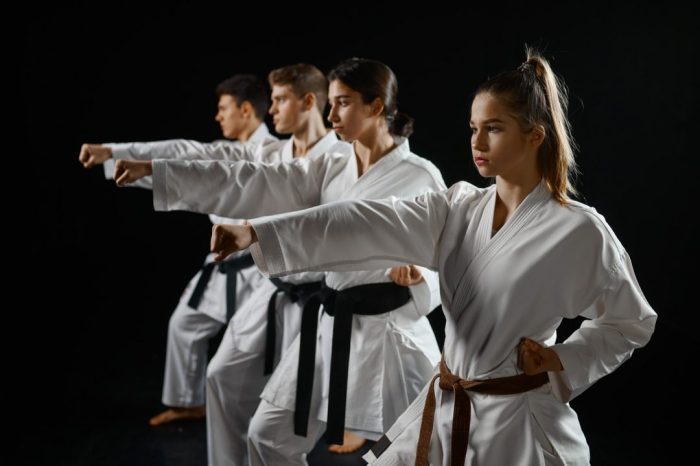
In conclusion, the Karate vs Taekwondo comparison reveals more than just techniques; it showcases a blend of cultural heritage and personal growth. Whether you are drawn to the disciplined strikes of Karate or the agile kicks of Taekwondo, both martial arts offer profound benefits that extend beyond the dojo, enriching physical fitness and mental resilience.
Essential FAQs
What are the main differences in techniques?
Karate focuses on hand strikes and kata, while Taekwondo emphasizes kicks and sparring techniques.
Which martial art is better for self-defense?
Both can be effective; it depends on the situation and the individual’s training.
Can I practice both Karate and Taekwondo?
Yes, many practitioners cross-train to gain a broader skill set.
What age is suitable for starting these martial arts?
Children as young as 4-5 years can start, but it’s best to check with local dojos for age-specific classes.
Do Karate and Taekwondo competitions follow different rules?
Yes, each sport has its own set of rules and scoring systems for competitions.